There Are Swans in the Lake

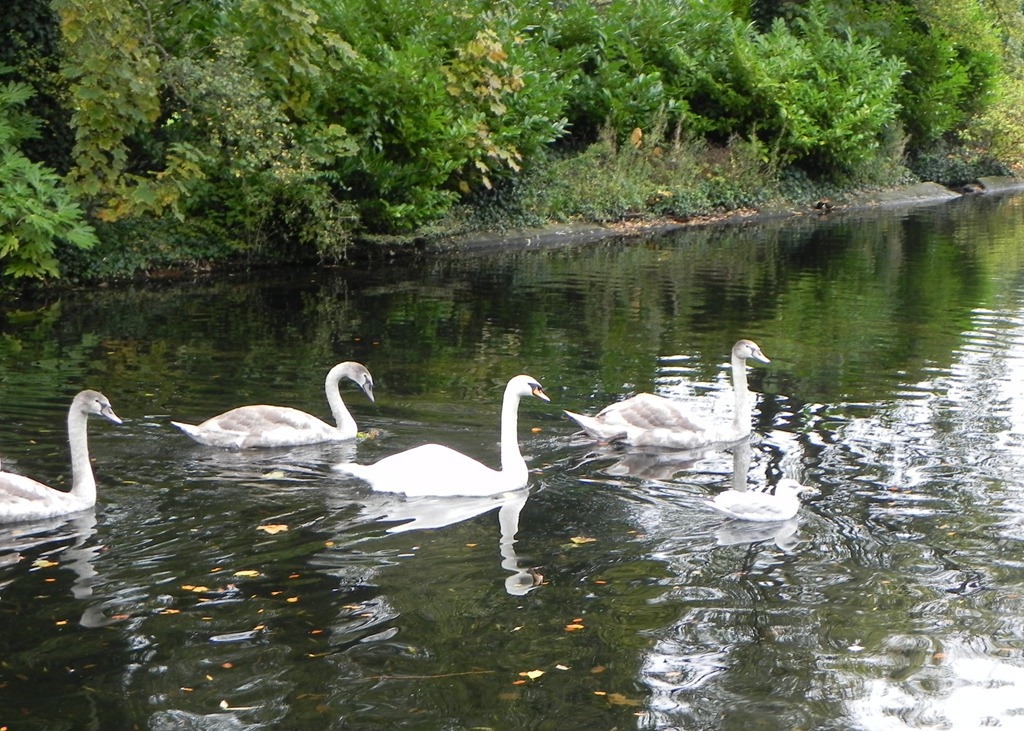
There are swans in the lake down in St. Stephen’s Square.
If you look in this world, you’ll probably find
There are swans all around everywhere.

In the high desert air, along black lava cliffs,
There are dry artemisias, bearing dry yellow flags
Of small seeds since escaping those wombs.

On cold northern prairies along frozen windows
There are crystalline messages etched on the panes
There remaining ‘til vernal winds blow.

On the streets of San Pedro, below coffee trees,
There are warm glowing birds of small children’s bright smiles
That stand out like the white Irish swans.

There are swans in the lake down in St. Stephen’s Square.
So now look in this world, and you’re sure to find
There are swans all around everywhere.

Christmas 2012

Yet another inversion of good sense

Growing Gap Between What Business Needs and What Education Provides

   The priorities seem a little skewed here. Is the purpose of the education of America’s children to feed the interests of business above providing their development as complete persons with quality lives? Or is quality of life only determined by one’s ability to feed the machine? If all children were educated broadly and deeply, would some not choose to thrive in a business environment and help it prosper? Or would the problem be an extension of the raging "never enough" attitude? Never enough productivity. Never enough profit. Never enough. If "business" – and just who we mean when we say that, I’m not sure – were as concerned with quality of life as bottom lines, we may have a sufficiently common interest to have success all around.
   First, if we get away from the ridiculous notion that everyone needs a college education – good for the education industry – and assist the educators in providing the actual skills needed, we would get better results. Schools are not factories producing products to compete on the open market. And educators are not likely to jump on the dehumanizing process of developing better widgets. A team effort would certainly help.
   We must face up to the reality that societal change, not institutional change is what is needed. We suffer from institutional feudalism, and we need to shift to a more open and collaborative system. As any modestly educated individual will have observed, the decline of feudalism and the rise of the merchant class was also a period of booming creativity, and it drew heavily on structures and arts of the ancients to develop a launch pad for the Renaissance.
   I think a creative workforce who have passed through a period of business sponsored internship sounds brilliant, and the potential for a better quality of life while helping American business lead in the world sounds a lot more promising. Certainly sounds better than a life spend passing from grade to grade, school to school, job to job, employer to employer, as if we were spending 70 years going from one room to another with little more than a door to connect them – ending up out the back in the alley of retirement. Maybe we should start with some windows instead of just banging on the walls.

Spoken-word Week: Why dip into youth culture?

I’m going to write about my best teaching experience. It took place at Edison High School in Minneapolis, Minnesota in March of 2009. It was the best experience because it encompassed all the best things about teaching and learning: modeling the joy of meaningful learning, supporting students in directing their own learning, and honoring all of the demonstrations of learning. Of importance to them was a change in their thinking, mostly about themselves and their capacities, and about their interest in learning. I called the lesson Spoken-word Week. Of importance to me was the opportunity to learn with the students and as a participant on their field of engagement, to bond with them.

I am certainly not the only teacher to use spoken-word as a teaching tool. I wasn’t first or even remotely early in doing so. That is only to my discredit. I do take credit for something more important than a race to be first. My goal was not to be a good teacher; being a good teacher is professional vanity, and worrying about it is driving American education nowhere. My goal was and remains to help the students have a better shot at a good life. I have wanted them to know themselves and the world they live in and, using that understanding, to continue to learn and to flourish. In the end, I think we accomplished that, at least to the point of moving in the right direction. Moreover, we accomplished a coup on a broken educational system. Students gained the kind of understanding of the power of words that adds depth to reading and strength to writing beyond the shallow mandates of education policy. My four classes of sophomores did outscore other sophomore classes at Edison on state mandated reading tests, but my classes included the only sophomore honors English class. So much for comparison testing.

My goal in doing a Spoken-word Week has roots in my longstanding desire to do a better job of connecting with my students. I have always felt effective teaching, like effective parenting, is an act of mutual love. It is after all a very personal activity, nurturing personalities, shoring up vulnerabilities, meddling with a person’s thinking. It has to do with feelings as well as cognition. Good learning does after all feel good. Good teaching feels good too, and it’s no blind luck that the two good feelings are concurrent. To access this sort of relationship meant knowing myself and my students at more than a casual level, and attempting to access this relationship revealed how little I knew them. They were not white, middle class, suburban, adult males! And since I was teaching in a multi-racial, increasingly multi-lingual and multi-national urban district, none of them ever would be. I had a lot to learn.

As it turns out, this was a good thing. Not only did I learn about them, I also learned a little about how to learn about others. As a survivor of the hippie years, “white, middle class, suburban, adult male” was something I had already done and had been moving beyond. Here was an opportunity to enrich my life enormously, because an asset almost all students have is that they are not locked into the “who” about themselves or others the way adults are. But there’s a downside to that too; they aren’t often very good at explaining from whence their “who” was coming. They live their values, they don’t recite them. They may know that Our Lady of Guadalupe is significant in their community and may even know the story of the vision, but few know the connection to Tonantzin. So they weren’t able to tell me about their psychological and moral development or their cultural or historical roots. To help me know my students, I have turned to professional sources to develop that knowledge, which I could then use to refine and individualize my instruction.

So when the Minnesota Humanities Center[1] offered a two day workshop on East African history and culture in 2008 and another on Teaching Latino Students in 2009, I jumped at the opportunities. Such offerings were not available to me for teaching Vietnamese, Lao, Hmong or Bosnian students when those waves came. Teaching African American students has been for a long time buried in teaching race relations. Teaching American Indians is still suffocated under the blanket genocide denial. And help in how to teach to poverty is unlikely to happen in our free-market equity glut. At Edison, my students were African American, Latino, Hmong, Congolese, Egyptian, Somali, Oromo and European American. Among these were many practicing Evangelical and Roman Catholic Christians, Shamanists and Muslims. A considerable number were out LGBT and allies. About one fifth lived in homes where English was not used regularly and 95% received free and reduced cost lunch. One in four was homeless or highly mobile. The Minnesota Humanities Center’s workshops were helpful to my understanding this feast of diversity. They gave me a cultural math to count my blessings.

From the East African history and culture workshop, I learned about the history of the region of the Horn of Africa and its relationship to Ethiopia, the European colonial powers and, of course, Islam and the Arabian influence. I also learned that oral poetry remains the traditional literary form of Somalia. Poems are created and recorded on cassettes now, and these are copied and distributed widely, their poets virtually universally recognized, respected and cited without any copyright law. The poems often deal with an admiration and respect for the land, and at other times commemorate leadership and bravery in colonial resistance or tribal conflicts. Both themes are deeply bound to the cultural roots of the nomadic people of the region.

The workshop on teaching Latino students was even more explicit in using poetry to explore and declare cultural roots. “Knowing one’s cultural roots is essential to forming a complete identity,” was the message central to the workshop and widely held by those in cultural studies and social justice. An excellent recent example of this is the Tlingit produced documentary Smokin’ Fish[2]. Learning from whence one comes informs us greatly on where we are going, and where they are going is the biggest part of school children’s life.

Learning about one’s roots was not the only recommendation for identity building however. Also significant to understanding one’s identity is understanding one’s place in the world, one’s situation or condition. Abuse and oppression ranked high with my students. Poverty is so shamed that it was not owned by many of them, even though most lived in unhealthy and dangerous poverty. So my students steered well clear of painting themselves with that brush. Yet these were the highly charged energy sources that made the poetry purposeful. Their spoken-word poems would be a way to assert this developing identity, a way to fight back at damage, and move forward with pride.

At the time of the workshop, a spoken-word open mic club thrived on St. Paul’s Latino West Side, and YouTube offered tens, perhaps hundreds of videos of spoken-word poetry by Latino, African American, American Indian, GLBT and other poets. These were messages confronting the denial, damage and destruction of group and personal identity. Victims spoke out against their abusers. Oppressed spoke out against their oppressors. A few spoke out about the liberation of being able to speak out. The message was clear; who they were was not going to change and their identities were not going to be denied. That meant that how they were viewed was going to have to change. Because the students in the classroom were preaching to a choir, of course, the wide world did not change, but my students did. It was clear to them and me that it is not necessary for any of them to accept the flawed view a repressive society had of them. Who they were and were going to become was up to them. These young poets stood up and declared who they were. They expounded a view of their world past and future that was theirs. They spoke with strength and pride, and that was just what my students needed to be able to do to break through the ceilings of race, language, culture and poverty that limited their futures.

That was my goal: empower students to be themselves and assert themselves into the best life possible for them. Spoken-word poetry was the vehicle, their identity the engine, their personal and cultural experience the fuel that would carry them forward. Would this improve their language skills? Students learn to read and write according to their perceived need for these things. Would the power of words to set one free, and the opportunity to be accepted and respected as ‘who one is’ help shape that perception? If this activity could open a door through which the possibility of a better life would appear, then walking through that door would indeed require one to develop one’s language skills. Pedagogically then, this was a good thing to do.

As a lover of literature who favored nineteenth and early twentieth century British novelists, I found spoken-word coarse and grating. As a privileged 63 year old, planning to retire from the classroom in just over two years, I had nothing to gain by going so far off my turf. But as a teacher, I had no choice; I believed this was the best thing I could do with my students. And I was right.

I would have to learn about this stuff with them. In fact, I would have to learn more and sooner. I would have to learn how to learn this as a student as well as learning about it for my knowledge base and lesson planning. Learning, however, is something I do well. I immersed myself in examples of spoken-word, listened, watched and reflected. I read about spoken-word and its background and activity—Harlem Renaissance, beat poets, hip-hop, Nuyoricans, Gil Scott Heron, Bob Dylan. I read about the background of Somali poets and poetry, and contemplated the parallels to Western styles. I explored how the poets worked and where they performed. As a past actor, I appreciated the value of sharing space and time with a performance. The dynamic of that sharing is unique in its immediacy and temporality. I understood that memorizing meant rereading and reexamining text for a deeper connection. As a poet, I knew that poetry can capture and express that about which we might otherwise say there are no words. I began to plan the lesson. They would have to do what I had done to learn what I had learned.

What have I done?

The lesson was simple: introduce with examples, discuss with open-ended questions, explore on the Internet for inspiration, write as groups—comparing and sharing as you go—refine and rehearse, present and listen to presentations. It would, I thought, take about a week to create and another to present.

Did this work?

Well, “work” is a relative term. Did this show demonstrable results on standardized tests that indicate something about America’s competitiveness in the global marketplace of the future? I don’t know, and frankly, I don’t care. I care about the individual student’s competitiveness in the American workplace, and I care about what the students see in the commonplace of a mirror. And in this assessment, it worked.

The most requested activity from the same students in the following year in my junior classes and those of others was classroom or school-wide open-mics for spoken-word. Their genre had been honored, their language had been honored, their words had been honored and they had been honored, and they liked it. Several of the students participated in an emerging spoken-word club and a school-hosted, public open-mic. A few participated in the city-wide slam later in the spring.

One poet, using the piece she wrote for my class, won an award at the city-wide slam. Hers was an intensely personal piece exposing the pain and rage her sexual abuse and the eventual forgiveness of her perpetrator. Najma, on the other hand, was able to leverage her college admissions the following year with the poetic skill demonstrated in my classroom, where she stunned her American classmates with an incredible, memorized poem expounding the endurance of national pride she held for her homeland and its people. Before her performance, she was simply another demurring Somali girl. From almost all, it was noted as the best, most remembered lesson of the year in my year-end survey.

I would have to say it worked because it changed their thinking about themselves and their capacities and about learning. And it worked for me because I modeled the joy of meaningful learning, supported students in directing their own learning, and honored all of the demonstrations of learning. Then I have often been the subversive in the system, who didn’t do as I was told and still got good results.

Would I do it again?

Well, I am doing it again. Now retired from the classroom, but still teaching and volunteering with the Latino Youth Development Coalition in Minneapolis, I was asked to help with a college entrance essay writing project for Latino middle and high school students. Their interest is to get these students, at high risk of dropping out, to start thinking about college as a real possibility in their lives. As part of what I will do in preparing them, spoken-word should help in focusing those with as yet forming self-identities, to aid in building a positive self-image, and to assist in revealing an understanding of their strengths and weaknesses that writing the essays will require. So, yes, I would do it again.


[1] Minnesota Humanities Center, 987 Ivy Avenue East, St. Paul, MN 55106, http://www.minnesotahumanities.org.

[2] Smokin’ Fish. Luke Griswold-Tergis & Cory Mann, Producers, Native American Public Telecommunications, 1800 N. 33 St., Lincoln, NE 68503, 2011.
That We Can Be One Again

I am from golf clubs and carports.
I am from golden woods and rolling meadows.
I am from tall cities and
~   Revolutionary War encampments.
I am from the right way to do things,
~   from our way to do things,
~        from thing we don’t do.
I am from a place of two worlds,
~   a place of white and
~        black.
I am from a place where fathers build fences
~   in the minds of their sons.
I am from a place of fences that,
~   having been built up,
~        must now come
~            down.

The fences that hide us from danger and
~   over which we hurl destruction;
The fences that keep ours for ours and leave
~   theirs for theirs;
The fences that make us into
~   us and not us
~        and make not us
~            into them;
The fences that have cracks that
~   show us slivers of what we want to see
~        of them;
The fences that have rotten planks that
~   reveal views of what being
~        not us has wrought
~            on them
I am from a place of fences that,
~   having been built up,
~        must now come
~            down again.

All fences must now come down
~   that sprung up in the light of day or
~        in the dark of night.
All fences must now come down
~   that fathers fostered in sons,
~        that mothers nurtured in daughters.
All fences must now come down
~   that make us different, separate, apart,
~        cut off, left out,
~           alone.
All fences must now come down
~   that keep us us and
~        them them,
~            us and
~                not us.
All fences must now come down—
That we can be whole again.

 November 2012

 Note:

~   This was written following a workshop with Shá Cage and E.G. Bailey at the Minnesota Humanities Center, St. Paul, Minnesota at their incentive and upon their model. It will be used as part of the identity formation lesson that begins the Latino Youth Development Coalition College Essay Project to be conducted this coming winter. They will start with an I Am spoken-word poem. So, yes, this is intended as spoken-word, though I believe all poetry is meant to be spoken out loud; it is an immediate art, a performance art. Story and poetry are rooted in the oral origins of all literature. All literature comes most alive when read aloud—a hint perhaps that all literature should be read aloud. Writing is, after all, simply a recording of the spoken word.

November 2012

When the water in the dogs’ dish
by the coffee shop door
is a broken chunk of ice,
encasing a single yellow maple leaf,

When a misty film grows
on the inside of the windshield
as the defroster blows moist air
that strains to clear the crystal
maple leaves of frost on the outside,

When the last rich aroma
of leaf mold and mums,
the last warm colors
of maple and aspen trees,
the valiant purple and blue asters,
have ended in an ozone of frozen air,

In a morning, in a moment it seems,
that’s when my mortality peeps
through cracks and around edges
and looks me in the eye.

November 2012

Assume Nothing?

We make assumptions. Some of these assumptions are so deeply embedded in our minds that we are unaware of them, but our world view is profoundly shaped by them. These assumptions define our reality and much of our identity. Fundamental fact: we are made of assumptions. Fundamental, unrealistic rule of living: assume nothing. Hypothesis: knowing and accepting those deeply embedded assumptions is knowing and accepting who we are.

As a teacher, I have used a simple exercise with small group of adult and adolescent students that helps them confront some of their assumptions, and with sufficient reflection, may have helped them more or less consistently confront assumptions in general. Each group of three to five is given two or three pennies. They all know what the penny is, of course, even though Visa and Square may be leading to penny obsolescence. The groups are then given these instructions:

You are an extra-terrestrial archeological team. You have arrived at a lifeless planet in a remote corner of space. The only evidence you have found that life existed here in some distant past are the objects you see before you. You may conclude from their material and general evenness of shape that they were fashioned, and not naturally occurring. All the rules of physics as we know then apply. We know they are copper, which is easily smelted from copper ore in a hot fire, for example.

What certain conclusions can you draw about their maker or makers from this archeological evidence? What speculations can you make about the makers of these objects? Conclusions require verifiable fact, what is known; assume nothing. Speculation combines fact and justifiable assumptions; make these very carefully.

The teams generally draw similar conclusions, which are really only speculations, and even then, flawed by supposition. They almost always make mention of Lincoln’s head on one side. This is a great place to start the conversation around the question: How do you know that? The embedded assumption, of course, is that the extra-terrestrials are sufficiently anthropomorphic to recognize a bas-relief figure on a disk as a “head” and all that goes with that. Big assumption?

Huge! We, as any science fiction writer will tell you, are desperately chauvinistic. Notice that the common language of the universe, with or without translators, is English, as in the Star Trek series and films. We accept that vocalization is the universal standard of communications; the use of English, because of the audience, has a better foundation. And sentient beings therefore have heads. It is simply how we can accept the vast possibilities of the universe, defining to the limits of what is known.

Science is at work to undo the two inconceivabilities we have been told about the universe: that there is empty space in it and that there is nothing beyond it—it goes infinitely on. The universe is finite, so must everything within it be finite and comprehensible. Nothingness and infinity are not humanly comprehendible. We can only comprehend through our senses. Try comprehending before and after time, by comparison. Our senses and our experiences are our assumptive limits, and only our imaginations can take us beyond. Yet, even the language of imagination must struggle mightily to get beyond the known, having simply been reordered. Imagination at its fullest power must enter the unknown; it must “go where no man has gone before.” A very courageous journey, but loaded with potential discovery.

Embarking on that journey requires the abandonment of those assumptions that shackle us, while at the same time using those assumptions to define our point of departure. Hence the penny exercise starts us on the process of identifying our embedded assumptions by simply forcing us to recognize their existence, subliminal to how our eyes and ears construct reality from reflected light and vibrating air molecules. The penny exercise can be the starting point of other enlightening pursuits as well.

Not only does the exercise force us to confront our limitations as imaginative beings, it also reveals to us the essence of who we are. Since our embedded assumptions are formed of experience, we can expect a more coherent and functional set of assumptions to arise from a more coherent and well-functioning set of experiences, given psycho-physical predispositions and freedom from traumas. Hence an early, on-going, rich set of experiences will position one better than a delayed, sporadic, diminished set. If the latter situation has occurred, the development of a solid personal identity could be doomed.

In any event, the embedded assumptions are essential to our identity. These are assumptions about how the world is or should be, and define how we are situated in that world. The world, reality, appears as it does because of our vantage point. Our experiences create a set of sensory inputs which have relationship to one another, and to us the observers. Those relationships define where we are in that cosmos, and where we are is who we are. We look out from a platform of assumptions about what the world is to see if things are more or less “like me” or “as I expect them to be” or not. That which is “not” can range from the familiarly different to the totally unknown, the incomprehensible. This perception of what the world is our provinces of reality, our crib, our family, our community, and so on as we develop.

As individuals move beyond their familiar provinces, they discover the world is largely not like them or what they expect. How one deals with that increasing assortment of otherness, is beyond this discussion, but in the absence of a fairly secure sense of self, managing life in a world of others is going to be a little tricky. What should one expect and what accept? When should one ask and when tell? Where should one be and where not? Needing to successfully manage this reality makes my argument for the formation of an clear and even strong individual identity. To manage in a world of others, we need a secure personal identity.

I think it also points us toward an argument for the sharing with and ultimately accepting of others as individual identities who are different but of equal essential value. Grasping the idea of one’s own unique identity and accepting that others also have a unique identity avoids the walls of categorical assumptions that have disabled constructive conversation. Thus we may begin the conversations between people that bind them into communities, sharing commonalities and understanding, often empathizing with their individual differences.

Beyond exercises like the penny archeology one, we should move toward deeper and more directed personal identity and community building activities—activities that are challenging, revealing, safe and rewarding. Such activities will require an environment where there are rewards without penalties for risk-taking, respect without attack in the presence of vulnerability, and where there is shelter without shame in any case. On the part of the teacher, there must be courage and faith, and, if it works, there must be Kleenex.

Petunia Blossoms

Stricken with drought, seared with heat
And abandoned to a brickwork patio,
Petunia blossoms festoon a poverty of rangy arches
As they seek escape from their life sustaining dirt.
Crimson, wine, burgundy velvet,
Elevated isolates of intense and florid wealth,
Suspended above the scorched and tenuous dregs of life.
Violet, purple, plum, the colors we will into midnight
When city lights bleach the skies, empty and lifeless.
Into these dark depth of summer comfort
We slide.
Into these singularities of a life envisioned,
Visions then swept into the darkness,
Passed into alternate realities,
As into momentary, transitory deaths,
We fall,
And find freedom from a harrowing now.

August 2012

Seasonal Quips

Spring Pops Up

Spring pops up one sunny day,
Turns snow to mud and then away.
Nighttime falls and then more snow.
Bloody spring, just show and go.

Summer

Summer slows mentality,
Slides a hand over the heart,
And saddens old sentimentality.

Marshy days ooze toward sodden ends.
Luminous dusks linger,
Resolving into shimmering specks,
While night weeps in the long grass,
And sleeplessness seeps toward dawn.

   Vivum est iudicium sine iudicio.

Falling (revised)

   melancholy drifting, floating,
   sepia, ocher, rust,
   bleakness seeping, dappling,
   watery, listless, drawn,
   on arching and forsaken blades,
   holding their breath,
   awaiting at last the fall.

Winter

   winter wants few words:
   cold and cloudy, wind and snow,
   the caw and clatter of a crow.

Defending Aleppo


Education Week – Teacher

Published Online: August 7, 2012

Five Practices for Building Positive Relationships with Students

By Kelley Clark

The objective is posted. The Do Now is ready to go. Your well-planned lesson is aligned with state standards, includes a variety of instructional methods, and offers opportunities for both summative and formative assessments.

What might still be missing? A strong positive relationship with your students, the kind of connection that makes them want to go above and beyond in your class.

Can you have a good lesson without having a positive relationship with your students? Yes. But …

Clark recommends and comments upon these five steps:

1) Leave yourself reminders on your laptop.

2) Never let the other students see you react inappropriately to a student’s comment.

3) Actually use the information you receive from a first-day student survey.

4) Schedule "bonding" time.

5) Finally, and most simply, learn your students’ names immediately.

Kelley Clark is a high school math teacher and member of the Teacher Leaders Network. She was the 2010 Secondary Teacher of the Year for Williamsburg-James City County in Virginia. She earned her graduate degree from the College of William and Mary and is currently a part of their clinical faculty program.
You can follow her on Twitter@kkssclark.

cited above


I opened and read this article this morning only to be discouraged by the minimal simplicity of the five practices, which seem to me only humane, and moreover by the promotion of these practices as something teachers, even new teachers, would not have been told, in case they hadn’t already figured it out, by colleges, colleagues or workshops.

Building relationships with students seems to be a natural, even automatic inclination for anyone interested in teaching. For the few who aren’t this sort of person, there was and should still be instruction in the importance of relationship building in introductory college education courses. AFT’s ER&D Foundations course has promoted and articulated a much deeper, research based set of practices to build relationship with students since its inception in 1981. The press, as in the case of Marzano’s articles and books, have preached relationship building for at least as long. John Dewey wrote about it nearly a century ago. Yet here we are teaching teachers to be humans at such a fundamental level.

Perhaps the new normal is understood to be the capitalist constructivist nature of our global economy, and education functions as component assembly for this knowledge industry. This norm has already begun to replace the humanities emphasis with the economic emphasis, humanity v. economy. Even so, the marketing side would tell us that the perception of being liked will increase our readiness to trust and purchase. So too with the students: “I like it that you’re being so successful on these otherwise mindless, heartless online tests.” And there is an academic return when students feel cared about, especially the most needy students. Of course, it is much easier to achieve this perception of being loved when the teachers really cares about her or his students.

And that brings me to the real question: Why would someone become and continue to be a teacher if they didn’t actually love the kids? Kids, all of them though perhaps not all the time, are so great it should be easy to care about them, and feel that they all deserve the best education. And they will give as good as they get. It turns out that when you want them to succeed, they want to succeed. They are the other half of the relationship. Care about students, and they will, as far as they are capable, care about you. Teach them because you care, and they learn because they care. This by the way is even more pronounced among distressed populations.

Clark may be right on target with her five practices, but if she is, it’s plain to see why American education is in trouble. If we need to be taught to teach with compassion, we must be suffering from a debilitating emotional ineptitude. Human emotions are assets, not encumbrances. Caring is purposeful in the survival and maintenance of the individual and community and species, but it seems it is becoming vestigial. Perhaps in a cut-throat economy, we can learn to live and die without caring.

Thanks, Kelley. Soldier on. I just hope you aren’t defending Aleppo.

Falling

Axe

melancholy drifts down

in ocher, sepia and rust

watery light dapples bent blades

of emerald and verdigris

life holds its breath

and waits for the fall.