The Ape Ariseth

We have become the most advanced apes, and we wallow grandly in our apishness. Tool use, once thought to be the haute domain of humans has been grudgingly relinquished to the ape world. We hardly even talk about other tool users, dolphins, elephants, crows, octopuses (octopi?)…

We have far outrun the pack in tool use though. With the entrance of the computer and the dawning of the Information Age, we took tool use to its farther extreme—emulating the gods with our use of tools. Elevating science, technology, engineering and math to the supreme arts, we have banked our education, business, wealth and future on our use of tools. Planted before the stony backdrop of an obdurate universe, the ape has risen to swing his awful club in the face of God. En garde Ahuramazda!

Now we have 3-D printers. We can recreate our world in bits and pieces. One day, it is predicted, we may be able to use such tools to recreate food. If food, why not sexual partners? STEM is pretty sexy—the reddest apple, dangling just within the touch of our finger tips, soon to be fully in our grasp. Imagine life on the holo-deck, lounging on the holo-beach, munching holo-lotus seeds.

The earliest Star Treks were, for the adolescent minded, fascinating in their gimmickry, scope and power. Yet Rodenberry used these to deliberate upon matters of sociology and philosophy, for those of us who troubled our minds grappling with such things. These vagaries were the places no one dared to go. How will we use our godlike power tools then? And for whose benefit? To whose detriment?

But it is much more fascinating monkeying around with our newest tool—a word not far removed from “toy”—than it is to grapple with abstractions. Ah! Making sense of abstractions, bringing order to the chaos of what is only imaginable. Attempting to understand our place in the incredible fabric of the universe. Now that sounds like something even an octopus might struggle in coming to grips with.

Humanity is not data-driven

There is much concern about the “Learning Gap.” The learning gap is really two undeniable things: a shame for our purportedly egalitarian society and a measurable fact. The ‘shame’ is in many aspects comforting and the ‘fact’ bears all the weight of the fact that there are three sheets of paper sticking out from under my computer monitor. We choose shame; it’s a feature of our Judeo-Christian cultural origins. We worship facts because they are sure and fixed and immutable. And the Learning Gap is characterized by the gap between the objectivity of the facts—data, and the subjectivity of the shame it engenders.

The ninety-second of the Roman Catholic dogma, one of a set of beliefs treated as fact for nearly two thousand years, states, “Original sin is transmitted by natural generation.(1)” We have been working on our inherent shame, treated as fact, since the conceptions of Cain and Abel. Meaning no disrespect for the great good done by Catholicism toward alleviating pain and suffering, The Church has like so many power structures simply cultivated, if not having actually manufactured, a need that it was prepared to meet for a price. Our hereditary shame, our original sin, deprives us of eternal bliss, but the Church provides an avenue to redemption. We need only do a few simple things: admit our undeserving state, accept the course our spiritual leaders offer and behave as we are told. And it’s not just Catholics. Is it?

We must admit to our sin in creating the Learning Gap. And they tasted of the fruits of class privilege and they knew their sin. We must accept the sanctity of the education reform movement. And on the seventh day they will be tested. And we will be redeemed. And the winged graduates ascended into college. And the “big data”(2) pushers should like this neat pattern correlation too. They ‘discovered’ the Learning Gap correlation, after all.

I say “discovered” because I don’t want to go right to the heart of the problem yet. You see, data are facts, and like the number of sheets of paper on my computer desk, they ‘mean’ nothing. When data are gathered, they can be sorted and arranged to create patterns, which in ‘data-ese’ are called correlations. Just before B goes up, A goes down—every time. Correlative fact, no cause, no opinion, just fact. This is the language of statistics, and we remember what was said about statistics, “Select the data that tells us what we want to know.” Could this be the case with the Learning Gap correlation? Could it be that the reason we find a difference in the performance in one racially defined group students from another racially defined group students is because something is or was going on to cause the difference? No. Because there is no cause to correlations, only data patterns. But we want things to have reasons.

“Why,” we ask, “are we here?” not just “Are we here?” Even Church dogma starts out by using the fact that we can ask as proof that there is a reason. Here’s what David Books says, with which I concur, in the New York Times, 16 April 2013:

“…I’m trying to appreciate the big data revolution, but also probe its limits. One limit is that correlations are actually not all that clear. A zillion things can correlate with each other, depending on how you structure the data and what you compare. To discern meaningful correlations from meaningless ones, you often have to rely on some causal hypothesis about what is leading to what. You wind up back in the land of human theorizing.”

Brooks contends that we seek meaning even in the meaningless and cause for the effect, and we do. It is probably deeply rooted in our psyche.

So why is the Learning Gap occurring between white students and students of color? Well, it is: no question about that. But that’s the learning gap: small “l,” small “g.” Why isn’t there isn’t the Learning Gap (capitalized) among rural, suburban and urban students, or between rich and poor students, or among the states or anywhere else that there is a gap? Well, we use race because that gap sticks to our inherent shame, our unresolved racial discrimination that we so proudly – no wait, make that, shamefully – celebrate in this country year after year. So shame can be made useful.

And the policy makers of today, like the Church leaders of the past, know how to leverage their influence and shepherd the sheep. “Close the Gap to relieve your shame.” But it may not be in the interest of that leadership to resolve the Learning Gap; it may be more useful to keep it in play. How much top down management, often in the form of cost containment, has sprung from the Learning Gap Card? Where does the power rest in dealing with the Learning Gap? And here’s the big one – If the Learning Gap were actually closed, what meaningful goal will have been achieved? How will it be more that a statistical non-correlation of data? Will the color lines go away? Will wealth be distributed more equitably? Will opportunity be truly equal? Will the nation become de-Balkanized?

_____

Those who know me know I have been railing against the obsessive elevation of data, the passionate collection to these completely dispassionate pieces of stuff, often with no prior purpose, and the religious commitment to the value of any correlation divined in the data for years now. I am increasingly convinced that data, as the raw material of the Information Age, can be capitalized, that it can be used to our benefit, or abused to cost. Moreover, similarly to iron or coal or oil, data can be manipulated to greedy ends in this Age of Greed.

Don’t let anyone tell you that the data are indisputable and non-judgmental. The choice of which data to bring forward is certainly disputable and the judgment about which correlations to divine must be highly suspect for hidden causes. Humanity is not data-driven.

_________________________________________

(1)   Loughnan, F. John. Dogmas of the Catholic Church, The Divine Work of Creation, The Doctrine of Revelation Regarding Man or "Christian Anthropology," Revised Feb. 16, 2001. retrieved from http://jloughnan.tripod.com/dogma.htm, 16 April 2013.

(2)   Mayer-Schonberger, Viktor and Kenneth Cukier. Big Data: A Revolution That Will Transform How We Live, Work, and Think, Eamon Dolan/Houghton Mifflin Harcourt; 1 edition (March 5, 2013).

Entertain versus Educate

In my email this morning was an update from the National Council of Teachers of English on LinkedIn. A group member from Australia had posted under the heading “Are You Trying To Engage Your Students Or Entertain Them? ” with these questions: “Should we use entertainment to engage our students? If you are using entertainment to engage your students, is this a less effective way to teach?”
sets

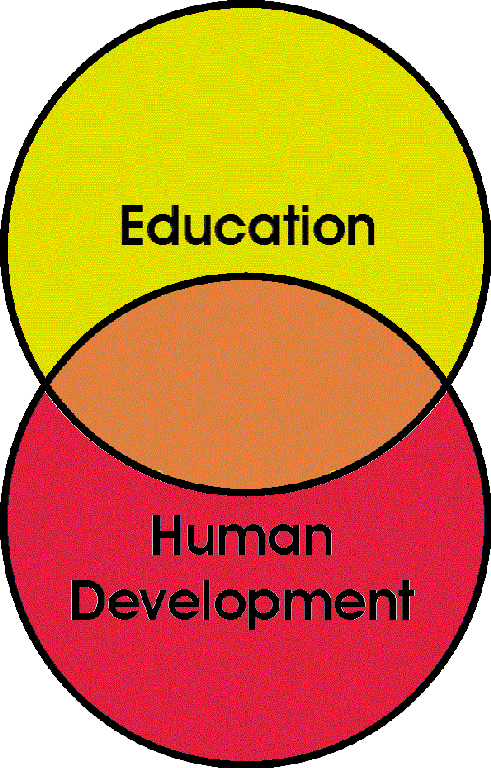
I remember this debate from decades ago as Entertain versus Educate. Now after years of realizing that getting attention was a challenge, but that underestimating kids was a trap too easy to fall into, I have to wonder why the debate continues. The questions in themselves suggest a limited and simplistic perspective of teaching and learning. I use the terms ‘teaching’ and ‘learning’ purposefully here, because they are but two, albeit significant, pieces of the human development process, of which education itself is a shared set. Education is a major part of human development, but it extends to other areas of our existence too. It helps to sustain as well as develop us. The reason this matters is that the member’s questions trap us in a decontextualized viewed of a single teacher activity—frontal performance. And disconnected from the greater whole of assisting human development, the questions lead nowhere; whether the frantic pup chasing her tail catches it or no means little, except perhaps to the pup—at the moment.
Yet the questions are legitimate enough in the arena in which they are offered. For many decades—I would say since John Dewey—educators have been reticent about asserting what they understand—when they do—about what happens in successful learning environments. For me, it was an epiphany that classroom success is what the kids do, as in learning, not what I do, as in teaching. And while this would suggest that what the teacher does to achieve engagement is important to that learning, it is not to say that entertainment is equivalent or necessary to engagement. That notion, I believe, comes from the influence of marketing in the age of television.
When education policy is so dominated by the American competitive business model, is it any wonder that we see teachers asking questions which might easily be rephrased as, “Should we use entertainment to entice our students? If you are using entertainment to entice your students, is this a less effective way to sell?” I viewed the British Arrow Awards at the Walker Art Center; entertainment sells and selling entertains. I have concluded that the question isn’t whether or not it teaches, however. That question only arises in a culture wherein the teacher can be seen as the manipulator and the student as the manipulated. Marketing is about deception, misdirection, generating needs, and satisfying immediate gratification. Yes, it informs about products and opportunities, but it does not invite thoughtfully making decisions based on holistic or long-term needs and goals.
I suggest we try to move the messages beyond entertainment in the classroom toward how we can help students in “thoughtfully making decisions based on holistic or long-term needs and goals.” Does entertainment have a place in this? I think so. Our students, in the over-developed countries, are awash in the catch-phrase culture of commerce, the sound bite polemic of politics and car crash nuance of news. In this era of super-superlatives, it may not be necessary to be the very most entertaining absolutely all the time to get the very best from your outstanding students. My students, and I would bet yours too, are better than that. Kids are good and they want to be and do better. What’s more is that they are reasonable.
Entertainment is fine for keeping it a little lighter, breaking the ice and dealing with failures. Learning will happen when kids see something in it for them. If you do anything well for your students, it should be to help them see the long view. Help them visualize goals for their lives and plans for how to reach those goals. Help them understand how to tell shit from Shinola, how to make decisions informed by the realities of their lives and futures. In short, help them take control of their lives; do not try to control them. Show them the power of thinking. Thinking is a highly desirable form of engagement.
Teaching is nothing by itself. Teaching and learning on the other hand form a partnership vital to the success of all. Teaching empowers learning. And if you teach for the adulation, you will get nothing like the letters I get now from students, whom I tried, apparently with some success, to empower twenty and more years ago when they were 12, 13, and 14—the “unteachable” ages.
Try this little experiment: challenge your students to entertain you in your subject area. Perhaps they should start by working in groups to create the most entertaining lesson on a new concept, formula or experiment. Check what you learn, and use it as a teaching strategy later. Or have them teach you about what’s important to them in an entertaining way. Maybe teachers should think in terms of engaging in learning with their students, and get beyond entertainment as an end or a means.

Letter to the Legislature

Greetings leaders in Minnesota education,

The education of America’s and especially Minnesota’s young people is never far from my thoughts. We are at a time when the drill in learning is very narrow and intense, but neither as deep nor as broad as the human potential. Even my own children seem governed by finding the right answers, and looking no farther until those answers falter. Yet in recent years we are seeing a resurgence of the thought process over the right answer, as if thinking were the diamond long buried in the mud of modern education policy. Critical thinking is coming back.

For over thirty years, a proponent of critical thinking, I urge you to consider the outcomes of our educational system in terms of human beings and quality of life over corporate profits and quantity of data. Critical thinking must take a front seat in the learning process. How we think is how we will be able to learn that which is not yet known. We need a future generation capable of shaping a world that we cannot now imagine, not a generation shaped by the last two decades of wealth acquisition in a digitized environment.

Here is an article supporting my contention that the sterility and superficiality of our bubble test education system is failing our children and youth: “Deep Education,” Francois Victor Tochon, University of Wisconsin-Madison. Beside feedback from academics, there is similar reaction from the business world to say schools must look beyond today to prepare young people for tomorrow, not yesterday.

Outside the politicized arena of schools as data factories for the world economy contest, there is still hope for schools as places to educate a Great American Society. Innovation must be more than a catch phrase; it will be the reality in a future of constant and untested re-invention. The foundations of learning are a vital jumping off place, but will our students have the stuff to take the leap into this unknown?

For the sake of our young people, please step back and consider the wisdom of our current policies. What would teaching and learning look like with the politics taken out? Put Minnesota back in the lead in education.

Respectfully,

Jay C. Ritterson

Dreams

Another evening, as the light grows dim,
And crystal cold air crackles around the black oak,
The last few sparrows dart and chitter, grabbing one last seed.
Snow drifts down, silent, peaceful and dreamy.

In the dark come the dreams of sun and green.
In the petrifying cold come vague sensations of softness and warmth.
Behind the frozen puffs of breath come phantom whiffs of rain and trees in bloom.
In the deadly grey and black of night come fantastic visions of flowers dancing in the wind –
.     Tulips, jonquils, scillas, snowdrops –
.     Red, yellow, blue, white –
.     White as snow.
Another February night drifts into snowy blackness and dreams of spring.

February 2013

New Unionism

New Unionism

The trend is undeniable. Unions will not be what they have been. But what will they become? One end is “gone.” Every other possible outcome must then be “different.” If unions are about protecting workers and worker rights, the union leadership had better change the shape of the union to match what the workers feel they need and to what they are entitled that they are not getting. That may be something other than money or political influence. Whether management is on steroids or labor is suffering dystrophy, might will not yield rights in a fight. The need to belong to an organization of fellow souls is probably meaningful to humans. Discovering the commonality of souls must be the first task of New Unionism.

Cardinal Degradation

Stands a red bird ‘mongst the sparrows
On my neighbor’s backyard grill,
Indignant at the chaos he endures

There among the raucous chatter
Of the avian rabble’s prattle.
Finds piety counts for nothing on these shores.

But the card’nal works the table,
In the bitter winter snows.
He can’t just spread his wings an’ up an’ go.

January 2013

On a Mountain Pass

From the banks and curves of a sunny meadow,
The white road dives
Into a brooding spruce curtain,
Its dark green deepening darker still
Under its emerald arms,
Its tops impaling an infinite sky,
Its deep blue darkening deeper still
Toward a sapphire zenith,
An arc etched on a mountain pass,
Its brilliant white glinting brighter still
Across the diamond crest.

The scene is ever caught, frozen, fixed,
A crystallized, thin-air gasp, instantly silenced,
Beauty motionless, soundless, timeless,
The place between one second
And the next, and now eternal,
Frozen in the ice of time,
Sealed upon the soul’s eye,
A green, blue and white land,
A memory before story,
Met forever one winter day,
A chance unlooked for and profound.

January 2013 – 40 years later

There Are Swans in the Lake

There are swans in the lake down in St. Stephen’s Square.
If you look in this world, you’ll probably find
There are swans all around everywhere.

In the high desert air, along black lava cliffs,
There are dry artemisias, bearing dry yellow flags
Of small seeds since escaping those wombs.

On cold northern prairies along frozen windows
There are crystalline messages etched on the panes
There remaining ‘til vernal winds blow.

On the streets of San Pedro, below coffee trees,
There are warm glowing birds of small children’s bright smiles
That stand out like the white Irish swans.

There are swans in the lake down in St. Stephen’s Square.
So now look in this world, and you’re sure to find
There are swans all around everywhere.

Christmas 2012

Yet another inversion of good sense

Growing Gap Between What Business Needs and What Education Provides

   The priorities seem a little skewed here. Is the purpose of the education of America’s children to feed the interests of business above providing their development as complete persons with quality lives? Or is quality of life only determined by one’s ability to feed the machine? If all children were educated broadly and deeply, would some not choose to thrive in a business environment and help it prosper? Or would the problem be an extension of the raging "never enough" attitude? Never enough productivity. Never enough profit. Never enough. If "business" – and just who we mean when we say that, I’m not sure – were as concerned with quality of life as bottom lines, we may have a sufficiently common interest to have success all around.
   First, if we get away from the ridiculous notion that everyone needs a college education – good for the education industry – and assist the educators in providing the actual skills needed, we would get better results. Schools are not factories producing products to compete on the open market. And educators are not likely to jump on the dehumanizing process of developing better widgets. A team effort would certainly help.
   We must face up to the reality that societal change, not institutional change is what is needed. We suffer from institutional feudalism, and we need to shift to a more open and collaborative system. As any modestly educated individual will have observed, the decline of feudalism and the rise of the merchant class was also a period of booming creativity, and it drew heavily on structures and arts of the ancients to develop a launch pad for the Renaissance.
   I think a creative workforce who have passed through a period of business sponsored internship sounds brilliant, and the potential for a better quality of life while helping American business lead in the world sounds a lot more promising. Certainly sounds better than a life spend passing from grade to grade, school to school, job to job, employer to employer, as if we were spending 70 years going from one room to another with little more than a door to connect them – ending up out the back in the alley of retirement. Maybe we should start with some windows instead of just banging on the walls.