What you need to know and how you can use that information. 
Presentation for all ages –citizens, naturalists and scientists – beginners to knowledgeable.
Why should people know about bats?
Bats descend from tree dwelling mammalian neighbors of the dinosaurs and remain intricately involved with our natural world today.
- Bats represent a unique model of animal evolution over the past 75 million years
- Bats play an important role in the balance of life and economy in nearly all parts of the world
- Bats play an important role through insect control in agriculture and residential areas, saving billions of dollars every year
- Bats and humans can coexist and even benefit mutually. We’re both part of the intricate fabric of life on this planet…the only home we have and share.
Batty About Bats
Kids love all sorts of animals – while they’re still kids. Adults not so much so. We’ve learned and accepted much about the natural world that is misleading, distorted or just plain false. This roughly 45 minute presentation 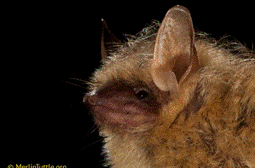 honors kids’ openness and at the same time helps dispel some of the misinformation that actually threaten bats’ survival.
We’ll talk about what bats are found in Minnesota, some basics about how they go about their lives, what threats they may face, what we can do about it and most of all why it matters.
Audience: Family
Tri-colored bat, MerlinTuttle.org
Threats and Actions
Minnesota bats are under extraordinary survival pressures. Bats greatest source of threat comes from human 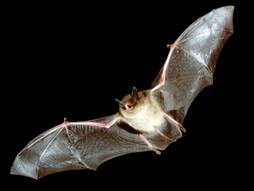 activity, some of which has passed a tipping point and may spell the end for some species. That’s the shameful bad news, but there’s some good news buried in it; human activity could slow, stop, even reverse trends stemming from some of the threats.
We’ll talk about the range of threats and their mechanics, leading to actions we can take to help reverse the trends. 45 min.
Audience: Naturalists, wildlife advocates, farmers and general public
Little brown bat. Bat Conservation International
Amazing Bats: a two part short course
Bats are truly amazing, and their very long participation in the development of the natural world we live in today continues to matter very much.
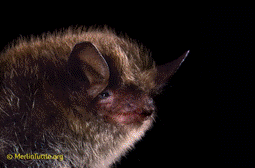 This two part short course covers bats from the time of the dinosaurs to the present. Presented as two separate 50 min. sessions or over a two hour span with a break, the first part reveals the evolution and distribution of bats, and the mechanics of their flight and echolocation. In the second part, we look at how bat threats have changed and the specific threats now faced, and what we can do to forestall further harm.
Audience: Naturalists, scientists and serious enthusiast
Little brown bat, MerlinTuttle.org
Who Am I?
A retired Minneapolis English teacher and trained Minnesota Master Naturalist Volunteer. I grew up playing in the Delaware woods. My family relocated to Minnesota in 1958. At summer camp, I took an interest in bats as part of a project, but did little until reconnecting with my interest in the natural world after I retired in 2011. My interest in bats was reignited. I quickly discovered how misunderstood were these fascinating and fabulous 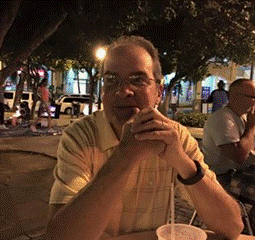 creatures of the night and of the air.
Live presentations are free to not-for-profit events. If an event site is greater than 100 miles from Minneapolis, some travel cost must be arranged.
Contact me as below for more information and availability.
Jay C. Ritterson, jcritterson@gmail.com


Life Is Not a Free Ride
13 September 2026 Leave a comment
Under the influence of current national politics, irresolvable international strife and a badly damaged global environment, the looming economic turmoil has the potential to worsen the cost of already troubled areas of life – food, medical care and shelter. It hardly matters what more positive changes occur in the near term; the momentum of declining quality of life seems overwhelming. We must do what we can to “gird our loins,” to salvage at least the basics of our accustomed lives, but not simply go back to what was.
We must not strive to recover the life we had, in a cycle of backward leapfrogging. We must instead deal with the conditions that are and plan for a future with justice, equity, and stability, here and abroad. After the fire, forward-looking survivors create water reserves and firebreaks while planting saplings and building new homes.
We must plan for a future in which everyone has a place and uses it responsibly. Mostly, we must understand that all life has value. We must work together. In the future, we must be focused on surviving, not just winning. We cannot continue as competing teams, or we will grind down the planet to a point at which it can no longer support life.
We must override the political short-term strategy and accept that we are morally responsible for the future consequences of our decisions and actions today. Life is not a free ride. We will pay a price one way or another.
jay@jaezz.org
Filed under Economic issues, Education Policy, Environmental issues, Philosophy, Politics, Social Commentary Tagged with The Future