[This is a rambling hodge-podge. Maybe there’s something in here.]
Our obsession with competition as a solution has thrown us all into Life Lotto. So here goes. I have twenty ziglets. I need six ziglets to make my mortgage payment, two for utilities, three for food, and five for my daughter’s tuition. She’s majoring in ziglet management and will make lots of ziglets in a few years. So I have four ziglets left. I can buy two chances in the billion ziglet Life Lotto game!
Now let’s see: my two chances…one billion ziglets…the Lotto Commission keeps 50% of revenues…Hey! My chances of winning are 2 in 1,000,000,000! Imagine that if you can. I certainly can’t, but I understand this: To have a chance to be a winner of the big ziglets, I’d have to start with a lot of ziglets. What if I earned a lot of ziglets? What if I could give myself a billion ziglet bonus on top of the two billion ziglet salary I already earned? (I not sure earned is the right word there.) I could buy a half a billion two-ziglet chances, and still have billions left over, and my chances of winning are even! I’d hold have half the chance tickets! These are good odds. But all I do is win back what I paid half the time, and lose half the time. The commission is the only winner, pulling billions of ziglets out of the system, mostly from the hundreds of millions of people who buy few chances and always, always lose.
Okay, let’s get rid of the commission. Free Market Life Lotto. Now we’re ready to fly. I buy my two tickets at 4 ziglets. The pot is doubled; it’s now 2 billion ziglets. My odds are still 2 in a billion, but Ms. Golds-Sackman is loaded with ziglets. She could buy half the chances, and the odds would be that she would break even over the long haul. Hundreds of millions of losers would still feed the process, and a very few – about one every other year, if Ms. Golds-Sackman nullifies half the game – would win really big and lose most of it by investing in the Golds-Sackman Brokerage Bank. So really Ms. Golds-Sackman wouldn’t play Life Lotto, because she profits by having more one-time winners investing with her. She knows the principle of Life Lotto: some people get all the ziglets and the rest of us just gamble ours away.
Okay. Everybody knows that lotteries are just big shell games. So why do we insist on applying the principles to everything else we institutionalize? In education, we pay rewards to the success for the most advantaged while denying the least advantaged the additional resources they need just to keep up. We tilt the playing field – The New York Times article “Administration Takes Aim at State Laws on Teachers” makes clear that there is a belief that all children arrive the same and learn the same and that all content is taught the same and can be tested in an assembly line model. States must be allowed to pass laws requiring teachers to be evaluated on student test scores, i.e., pay for performance. That being the case, the teacher’s class list is their available ziglets in the “…$4.3 billion Race to the Top competition…,” as the Times calls it. And it is a competition indeed. Teachers will compete for the best, most able students, compete to teach in the most well endowed schools, and will teach to the tests, no matter how shallow the skills they assess. Their goal is not to better the students; it is to best their colleagues. And with limited resources, most will still lose in the long run.
Lose? What about the children left behind? The students who have already to suffer the indignities of not being native English speakers, not coming from a home with two college educated parents, not having had adequate prenatal care, not having adequate healthcare, not having access to healthy food, not having a home to go to after school? The Principle of Life Lotto tells us that the odds of being a biracial child, raised by a single parent and rising to the presidency are very, very long, so long that just the novelty of it at all substantially reduced those odds. But now it’s not even novel. One off.
The obscenity of such actions is depicted in the article “Professor’s Arrest Tests Beliefs on Racial Progress” also for The New York Times. In the United States, we, meaning empowered mostly white people, mostly men, are pathetically blind to the world we have created and now blame for its shortcomings. The election of a biracial president has rightly returned the spotlight to issue of race, but not back to the core of the issue. It was empowered white people, mostly men, who defined race in the first place to define what would be allowed privilege and what would not. In our “classless” society, we have formed and cemented “class-like” definitions into our psyches, on all sides of all lines, with such success that we simply assume that there is a real difference because for hundreds of years we have said, there is.
We have built the walls along the borders of our thoughts, and we all hold those walls up in our minds no matter which side of the walls we are on. Walls are our societal Frankenstein’s monster that will obsess us and drive us screaming into the frozen waste to wrestle to some end. Like Dr. Frankenstein, we have no way to uncreate this horrible force that in its rage ravages blindly. Perhaps we need to start by understanding that we too are on one side of these walls, as those across our walls have always understood.
Then we need to release the limited resource of power. It was power, not authority that put up the walls. It will take power to bring them down. In the giving up of power and the taking on of power, we need to end the competition. Power, like ziglets, is a limited resource. Deserved power is backed by authority, which brings with it responsibility. These are human rights: the basic rights to make decisions about ourselves, in our own self-interest, without impingement on others, and to continue our lives in the form of offspring for which you are then responsible and therefore over whom we have some authority. Nothing in this empowers anyone to define “other.” There is no need to define other, unless we assume authority we do not have by sheer dint of power and for the sake of disempowering, that is taking power from, others.
What we have done has been to focus our struggle, not one neutralizing the definition of race, but over who has power, because it is clear to the people on one side of their wall that they don’t have the power that the people on the other side of that wall do have. The struggle has been to get over the walls. The walls cannot be removed, at least not entirely, because they are part of who we are and have been.
The empowered people, mostly white, mostly men, don’t recognize or won’t acknowledge the unauthorized power they have. Furthermore, when they do recognize it, usually rarely and only slightly, they are at a loss as to how to give it back. Most of us have been somewhat disempowered in other power competitions anyway. Remember the principle of Life Lotto: some people get all the ziglets and the rest of us just gamble ours away. But that’s just it. The more power one has, the more one can acquire. The rich get rich, and the poor… But do the white get whiter? Well, yes. Especially if you view Whiteness as something collateral to color.
Let’s say I’m biracial, but was raised mostly by my white parent side of the family. This could be a perverse advantage of single parenting. I look black enough to get into everywhere black. I can be trusted. At the same time, I know white. I can jump across the wall and look black enough to capitalize on white guilt, people like this writer who are going to encourage “others” to get into the power. I’m truly bi-cultural, fully functional in two, competing cultures. And I can use my great intellect (God bless the DNA that built a brain that can form dendrites easily.) trained at white power-culture institutions to maneuver easily into considerable power. What cultural traits, common language and/or beliefs, have increased and which been diminished to get here? What culture defines who I am and how I am? What defines any success in this country? From infancy to wealth and power, who has the most changing to do? Why will lottery winners never become powerful, and will probably never stay rich? Because the white power-culture has been consolidated into a super-norm that even most white people can’t achieve. Whaddaya think? Pick the winner:

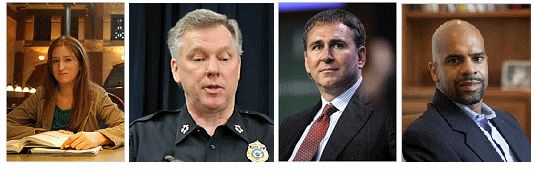
[1. Lost her identity, sorry; 2. Sgt. James Crowley who arrested Professor Gates in Cambridge; 3. Kenneth C. Griffin, 40 year old founder of the Citadel Investment Group, the $20 billion hedge fund; 4. Al Vivian, left, is a diversity consultant in Atlanta. images 1, 3 and 4 from The New York Times, image 2 from the Christian Science Monitor.]
In Life Lotto, is it hard to guess who has the power, just from the pictures? If you say yes, I’d wager you are way white, and are having a hard time getting what I’m writing.
Living in air doesn’t demand thinking much about air until the air starts to run out. It’s easy to see that those without enough air have the problem. It’s not easy to see that having so much of the air is the problem. It’s also easy to see why everyone is trying to get where the air is. It’s a privilege to be where the air is from the start. What percentage of your chances in this world is determined at the moment of conception? It may not make much sense when everyone, especially people who look and sound different from you, starts trying to get into your space, breathe your air, share your privilege. It may seem threatening. But here’s the real question: Who said it was your air? Whose air was it in the first place? Surely air wasn’t in the sole possession of the European aristocracy and subsequently spread throughout the rest of the world through benevolent colonization.
So as we race to the top, who gets left behind? Where isn’t there enough air? In teaching, it will be the teachers who need the most support to help kids learn, and are shoved aside to make room for new teachers. The first five years of teaching are the least productive, yet the Race to the Top will encourage churning. In learning, it will be the ones who start out behind. While the top is the target and the models are the Ken Griffins, we will never get those who start out farthest from that reality across the cultural wall into that game. If greed and avarice are deeply antithetical to your own heritage, it makes you a very poor competitor. And in life, it will still be the ones who are already gasping for air, playing Life Lotto, hoping and dreaming of getting across to a world they don’t “belong” in.
Who got to say what was top? Maybe we should just test the “best,” and forget the rest. We can define a new wall: education. Those inside the education wall will have most of the education, most of the ziglets, most of the air, most of the power. Real reform that will get us right to the top! We can build the wall on the foundations of classism and racism, maybe even sexism. Educationism!
Some people get all the ziglets and the rest of us just gamble ours away.


Cultural Neural Network
24 May 2010 Leave a comment
In recent years, I have grown aware of a newish way of people’s separating themselves out from and above others, a newer form of elitism. In the past, educated people were rather legitimately accused of elitism as they held themselves above the uneducated, unwashed masses. Those masses had the good sense to retaliate with a much more pervasive anti-intellectual movement. Long Live Homer Simpson! This making the elite look silly had to stop, of course. In an effort to recover some dignity from the ignominy of dummy-bashing in the PC era, the educated elite embraced those less favored in a new way—through their “studies.” Gay studies, women’s studies, cultural studies…, something like crosses between sociology and natural science. The result of this superficial shift in perspective is that the modes of discourse preserve the cultural disparity between haves and have-nots.
By studying discrete social groups, those who are educated can show some level of respect for “marginalized” people, much as we would identify an endangered species, but they still identify such others as not-themselves. “Othering”—assuming a position of power that allows one to say who is outside the circle of power and privilege—identifies and labels people who differ from an educated norm as “marginalized,” at once creating a category of people to study, award rights, offer respect, and in the same breath placing them at the margins of main-stream society. Marginalization can only occur from the center, after all. Liberal academics will tell you that it is other empowered elements that have placed such people at the margins of society. But privilege is privilege and power is power. The academics comply with this othering when they study the marginalized, not the process of marginalization. Were it any less the educated empowered, they would have set the conversation differently. As it is, academia accepts and supports, even thrives on, an axis and rim vision of society and its relationships to its people, one center, many margins.
I want to look at an entirely different model for thinking about cultural difference. This assumes that cultural difference is significant in some meaningful way and not just as a means of elevating some folks over others. Culture can be considered as a group of people who share characteristics that make them identifiably different from others. Members must understand membership in the culture at some level. A gang will have a culture, but a random group of criminals will not, unless perhaps, they share an extended period of incarceration. Cultural groups should empower themselves by coming together for the purpose of defining themselves in some significant and presumably justifiable way as different from others. Such self-defined groups should examine their defining characteristics and determine how their group identity serves the needs of their members. Cultural groups should be self-defined and purposeful; otherwise, there is no reason to separate themselves, or be separated from the herd.
Such self-defining places a cultural group at the center of its own wheel with relationship to other cultural groups each of whom is at the center of its own wheel, each spoke representing a unique perspective. There is no need for a cultural “norm” that defines those at its margins. With no central power, there are no margins. The visual image of the wheel becomes increasingly less useful as we picture many groups sharing spokes with many other groups. Taken all together, these self-defined groups and their tangle of perspectives and relationships becomes a sort of cultural neural network. With the greater society viewed as a sort of brain, studying itself becomes just that—studying itself, not one part getting to study all the others, but a collaborative effort that results in a vastly more powerful understanding of who we are and how we fit together in the world.
Academia may not like this arrangement, as it dislodges them from privilege and asks them to share power; although sharing it could increase their power. The educated do not need to define any group but their own. I count myself in this group, while others may count me out. So be it. Academia is able to define itself, e.g., diplomas, publication, or perhaps simply demonstrable facility with knowledge. Without its privilege of othering, it might be hard to see the usefulness of a culture of educated. And the educated would have to redefine their relationship to other groups, no more Us and Them. Group identity must be about defining ourselves, not excluding others. So with a network of cultural study groups, we could study and be studied by other cultural groups. We must first study ourselves, however. We must first know who we are, if only to answer others’ questions about us. Within each group, would almost certainly be members who are also members of other groups. Much could be gained by learning from this intra-group diversity. Once we know ourselves, there would be learning and sharing dialogues between and among groups where inter-group relationships exist. These dialogues must be two-way conversations that ask, “Who are you?” and answer, “This is who I am.” No more is there a single source that says, “This is who they are,” or worse, “This is who you are.”
What does this say about the universities and colleges courses of study? Cultural Studies becomes Intercultural Studies with academia serving as a forum and occasionally as moderator. The content of such programs would not be the content of the cultures, but the perspectives among selves. New questions would be studied:
“Who am I?”
“What do I see through my eyes?”
“Who is he?”
“What does she see through her eyes?”
“How do our perceptions matter to us?”
“How do our perceptions define us and how are we defined by our perceptions?”
“How does it feel to me us or them?”
“What are our dreams and fears, shared and at odds?”
“How can or should we change how we look at things and ourselves.”
This may not be the ultimate goal, and it will require new thinking and a reorganization of some deeply vested resources. But it can greatly improve how we could get along, and it could greatly increase our potential for making real and sustainable progress in social status and material wellbeing.
jay@jaezz.org
Filed under Racial Issues, Social Commentary Tagged with Education, Race and Power, Whiteness