I Learned Everything I Know from Wily Coyote

We may not like it, and we may not understand where it is leading us as human beings, but this is what is happening.
I sit here at a computer screen and I feel nothing for it, for it is a soulless and uncaring thing. I had teachers I loved and teachers I hated. With more maturity, of the thousands of students who passed through my classrooms, I had hundreds I truly loved as if they were my children–and some I was glad were someone else’s children, and I made a personal effort to do something good for even those. I never wanted to be rich or famous, but I wanted to be appreciated, and even loved a little. And I think maybe I was loved, a little. I am a human being, after all.

What is this brave new world we live in? And how is it that, in creating this new world, those I once cherished, now sitting on the other side of a computer screen, will blindly abandon their own children to the sterility and isolation of such an education? I at least lament their loss.
I retired with tears. And society may leave me beside the road to die at some point. Still, I am so thankful to have gotten out when I did. I did my teaching with passion and dignity. And I am rich beyond the wildest dreams of any plutocrat or their science and technology minions.

Where are the Unions Going?

                As I was going through my email this morning, I saw an announcement for a speaker from the Food Chain Workers Alliance. I have been thinking, off and on, for some time about alternatives to the traditional labor union structure that we are currently saddled with, and which is being driven into the ground by the relentless forces of greed. I see the FCWA as a model for organized labor to examine as a possible alternative to the across the table model in which we are bemired.

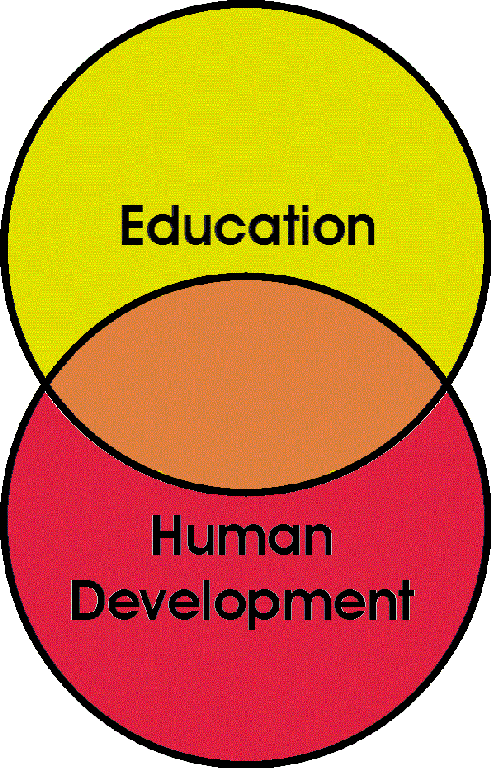
                It is a labor counterpart to the “wellhead to gas pump,” production chain control. AFT/NEA and others could evolve into parts of a Human Development Professionals Alliance, dealing with all those involved with the development of every child from prenatal medicine to college graduation. Think how this would align the development of citizens by democratically and largely locally organized engagement.

                It would of course take a much smarter and more knowledgeable mind than mine, but the overall concept seems positive, and unifies the development of American children into true American citizens. Of course, such a design works counter to corporate efforts to atomize society allowing them to more easily fleece their sheep. It shifts its emphasis from workers’ rights and wages to the tasks and quality of work; it negotiates how to get the job done for the benefit of all. Such an alliance would set its performance goals based on the needs of the employers and the desires of the people to become a society of their own making. And, oh, it would be tough to implement. The rich and powerful will not want to give up control of the peasant masses to use as cannon fodder in their global “econowars.” Many workers would not want to give up the petty monetary or seeming autonomy benefits of their patronized niche. There would be sacrifice and discomfort, maybe even real pain along the way, but then people have died in the labor movement of the past. And sycophants should have no immunity.

                Additionally, those who do the work, functioning as a whole, help to restore our corroded democracy. It has the potential of monitoring and developing its members into a cadre of the most desirable and qualified "workers," rather than the cheapest. Workers of the past negotiated for their muscle and bone. HDPA members would negotiate for skills and competencies, brains and commitment. Incumbent upon the alliance then would be the capacity development and quality warrantee of its members. Consumers, employers and institutions could have the best or the cheapest, but if they could have the best at a fair wage, these work providers would come to the Alliance. There they would get the performance skills necessary to maximize their job needs.

                This guild model combined with the end-to-end industry model is but one alternative unions must consider. We need only look at the numbers to see that the unions and the middle class that they generated is deeply eroded. In twenty or thirty years without real change, unions will be the “Jamestown Settlements” objects of the future, historically significant and quaint. We will, by then, be beyond class warfare; we will have become an economically occupied nation.

Why they are called the humanities

Well, the study of humans seems fairly hopeless. Doesn’t it? I mean first of all, knowing what humans are is the domain of physiology. Isn’t it? Humans are giant amoebas. Vast colonies of smaller organisms and microbes collaborating to achieve one thing—to continue. You know—to survive, to beat off competitors and to reproduce, hence to survive, etc. The current collective is only of value if it procreates; it’s the simplest of evolutionary principles. This iteration is insignificant; only replication counts.

So, what’s to study? If all we are, are self-replicating biomechanical devices, engendered by the quadrillionth roll of the carbon-based slime dice, the only thing to pin down are the genomic odds of any one of us happening. Of course we might want to study ways to make humans better at surviving the odds, sacrificing ourselves in the interest of assuring that there are children and children’s children. Logically, we should have as many children as we can produce, preferably of superior quality. Our off-spring will have to compete against all competitors for our available resources after all. Then we should bury our own future in the economic compost to contribute to the resources for our children, who must be competitive in an arena with neighbor children, so they can do the same for their more competitive children. – Oh, wait…we do that now!

Anyone who sees this existence as other than a seriously grim reality would, I believe, be someone who would neatly fit this definition, which is not humanity at all. This reality would be ours with all of our humanity stripped away, and that is not who we are. But it is all too much who we are becoming.

The study of the humanities is the study of who we have been able to become, well beyond the biomechanics of evolution. Yet, there is a close tie in the humanities to the physical human as well. The humanities appeal through our senses beyond food, fighting and sex. Free-marketeers, however, have certainly seen the economic advantage of mimicking the humanities to tap into these basic impulses, and this has not been lost on the purveyors of the humanities themselves. The arts use the visual and auditory to catch our attention and stimulate responses unnecessary for and not contributing to our continued existence, yet we come back to them over and over—Mona Lisa—Beethoven’s 5th—Tchaikovsky’s Nutcracker Ballet. Literature pulls us out of our reproductive cycling by using our sensory imaginations not just as a preparation for the hunt, but being transported into an alternative existence—Morrison’s Beloved—Homer’s Ulysses. And for what? None of these assure our great-grandchildren’s fecund existence.

The humanities help us build a context for who we are, as a species, as a people, as an individual. Among the humanities, history seems to hold a unique place. All that we have been is who we have become, and this story is what history tells us. Even how our history is presented—Euripides or Doris Kearns Goodwin—informs our minds eye, human voices sounding human voices from the past.

With a foot in two boats, philosophy has, for millennia, achieved something that the sciences have not yet satisfactorily achieved—seeing outside the solidity of the mundane. It is in this contested frontera between the lands of theoretical physics (a form of math) and religious exegesis, in this transcendent reality that philosophy carries us into an existence beyond all else, genuinely room into which to move as only humans can.

The arts, literature, history and philosophy are only unimportant if our world has not humanity, if humans are competitive rather than compassionate animals, if we are self-serving rather than self-aware beings. Who we are as humans cannot be gleaned from gathering food, fighting off raiders and producing children. An amoeba does that. We must see a much broader horizon, glimpse distant, misty peaks, be stirred by the striving songs of others, and to care and wonder why. The sciences may seek the answers, while the humanities will ask the questions for which there may be no answers.

If the humanities are allowed to dim into obscurity, how will we even know what we have lost? If that which lets us be human is gone, what will it mean to be human? Yet the sad truth is that we are not choosing to shed our humanity; we are offered new clothes which will let us appear as emperors of our domains, and we are allowing that, even inviting it. In whose interest is it that we discredit the humanities and embrace the sciences? Who benefits if we don’t ask why? How will we be served by diluting the uniqueness of ourselves in the engineered seas of progress? How will we know how best to move forward? And what is the price of our wealth, after all?

Philosophy tells us who we are

While I have not read widely on the subject of the Common Core State Standards and their implementation, I have read enough to see what appears to be a common core of arguments.

  1. We need national standards to be competitive in the global economy; vs. we need local control to assure our national character and integrity.

  2. We need the content and levels, specified in the CCSS, to assure quality in education across the whole country; vs. we need to honor choice, and regional and local values that are nurtured through our education system.

And my favorite:

  1. We need to be able to compare schools on a consistent scale; vs. we need to support every child in every school to maximize every individual’s innate potential.

Put another way, these might line up as:

  1. Globalism v. parochialism

  2. Uniformity v. individuality

  3. Free-market competition v. Marxist socialism

This analysis is based on a cursory examination of the commentary, to be sure. I would say “the literature,” but that would suggest a higher level of academic study on the part of the commenters. After all, implementing a nation-wide formula for education based on presumed outcomes is implementing a strictly probability-based inductive rationale. It’s a bit unrealistic for anyone to speak with grounded authority on the outcomes, though many might assume such a posture.

Something that I see in my analysis is a similarity to other arguments afoot across the world. All these argued positions are similar to positions taken in economics and corresponding social structures. And while this might be a loose relationship, it bears some consideration, because it invites the question, “What underlies the discourse on the Common Core State Standards?” In other words, why are we having these debates in education, economics, ethnic identities, and religious beliefs? Isn’t what’s best for the most over the longest time the goal? Apparently not.

I would say we spend far too much energy arguing the road to take and far too little energy trying to discover a goal upon which we can share consensus. In the CCSS debate, little seems to be said about what we agree on as the goal of a public education system: assimilation of diverse peoples into a single national identity? (1890-1910) The development of the human psyche as a spiritual being? (1920’s) The creation of a core of technical elite to direct and manage cadres of practical crafts and labor? (1920-1940) To establish an informed electorate to form a true democracy? (1940-1960) All right, these are rough, broad strokes, but they certainly represent raison d’État in public and, concordantly, private education in the U.S. in the last 150 years or so. And how unlike the gymnasia of Athens 2,500 years ago.

Thirty years ago, I puzzled over what was really expected of me in the classroom. Think for a moment about all the voices, many quite demanding and even threatening, If education is anything, I think, it is the institutionalized effort to acculturate and socialize emerging generations—to bring the rising population into the culture and society of a people. If that’s the case, then the problem seems pretty clear; The United States, by its design and history, is not a single people. At least not in the 21st century. We don’t have a common culture or a common society.

The debate, it seems to me, that we need to resolve is where we want to be on several spectrums. Where do we want to be, for instance, between absolute conformity – very efficacious, e.g. the Nazi war machine – or total individuality – apocalyptic anarchy where feudal war lords rise and fall trampling the masses. Please don’t be naïve; there are a few who would happily embrace the extremes. But there are deeper questions that we avoid even mentioning in practical arenas such as education. What is success? What is the balance between reality and fairness? What should determine what is right and what is wrong? What does it mean to be human? What does it mean that we can even ask such questions?

Philosophical (and religious) questions have plagued, entertained and elevated human beings throughout recorded history. Only physical conflict can compete for longevity, but cannot be said to elevate humanity; although it has elevated science and engineering. While STEM (science/technology/engineering/math) might suggest preparation in the field of conflict, though certainly very many other more humane fields as well, there seems to be little in the CCSS to promote the idea of questioning—the mean by which we clarify and understand—the philosophical puzzles. The world of science tells us what we are, but the world of philosophy tells us who we are. It is the philosophical that raises humans above the rest of the physical world, and leads us to ask “Why?” – the little child’s question that seems hardwired into humans.

So here’s what’s going to happen with the CCSS. It will be implemented poorly and unevenly and even incompletely across the states over the next five or six years, and will be overtaken by the next reform effort. During that time, it will spawn a sea of books, articles, research efforts and college programs—in their own reformed shapes—that will become an exhausted source of profit in the end. The new reform debate will generate a new wave of the same sorts of profitable sources in its turn. Cycles happen. The linden tree has a heart shaped leaf and, when viewed from a little distance, has a heart shaped profile as well. Patterns result from underlying, often mysterious, causes. Education reform cycles, and repetitions, I imagine, are in the underlying gene structure of society.

I gave up listening to all the voices (not in my head as it happens) telling me what education should be doing. Now that my career in the classroom is over, I feel satisfied that as the years passed, I was more and more able to get my students to ask why, in effect,  returning one starfish at a time to its home in the sea. I put my energy into starfish these days. I don’t see much point in trying to STEM the tide.

Humanity is not data-driven

There is much concern about the “Learning Gap.” The learning gap is really two undeniable things: a shame for our purportedly egalitarian society and a measurable fact. The ‘shame’ is in many aspects comforting and the ‘fact’ bears all the weight of the fact that there are three sheets of paper sticking out from under my computer monitor. We choose shame; it’s a feature of our Judeo-Christian cultural origins. We worship facts because they are sure and fixed and immutable. And the Learning Gap is characterized by the gap between the objectivity of the facts—data, and the subjectivity of the shame it engenders.

The ninety-second of the Roman Catholic dogma, one of a set of beliefs treated as fact for nearly two thousand years, states, “Original sin is transmitted by natural generation.(1)” We have been working on our inherent shame, treated as fact, since the conceptions of Cain and Abel. Meaning no disrespect for the great good done by Catholicism toward alleviating pain and suffering, The Church has like so many power structures simply cultivated, if not having actually manufactured, a need that it was prepared to meet for a price. Our hereditary shame, our original sin, deprives us of eternal bliss, but the Church provides an avenue to redemption. We need only do a few simple things: admit our undeserving state, accept the course our spiritual leaders offer and behave as we are told. And it’s not just Catholics. Is it?

We must admit to our sin in creating the Learning Gap. And they tasted of the fruits of class privilege and they knew their sin. We must accept the sanctity of the education reform movement. And on the seventh day they will be tested. And we will be redeemed. And the winged graduates ascended into college. And the “big data”(2) pushers should like this neat pattern correlation too. They ‘discovered’ the Learning Gap correlation, after all.

I say “discovered” because I don’t want to go right to the heart of the problem yet. You see, data are facts, and like the number of sheets of paper on my computer desk, they ‘mean’ nothing. When data are gathered, they can be sorted and arranged to create patterns, which in ‘data-ese’ are called correlations. Just before B goes up, A goes down—every time. Correlative fact, no cause, no opinion, just fact. This is the language of statistics, and we remember what was said about statistics, “Select the data that tells us what we want to know.” Could this be the case with the Learning Gap correlation? Could it be that the reason we find a difference in the performance in one racially defined group students from another racially defined group students is because something is or was going on to cause the difference? No. Because there is no cause to correlations, only data patterns. But we want things to have reasons.

“Why,” we ask, “are we here?” not just “Are we here?” Even Church dogma starts out by using the fact that we can ask as proof that there is a reason. Here’s what David Books says, with which I concur, in the New York Times, 16 April 2013:

“…I’m trying to appreciate the big data revolution, but also probe its limits. One limit is that correlations are actually not all that clear. A zillion things can correlate with each other, depending on how you structure the data and what you compare. To discern meaningful correlations from meaningless ones, you often have to rely on some causal hypothesis about what is leading to what. You wind up back in the land of human theorizing.”

Brooks contends that we seek meaning even in the meaningless and cause for the effect, and we do. It is probably deeply rooted in our psyche.

So why is the Learning Gap occurring between white students and students of color? Well, it is: no question about that. But that’s the learning gap: small “l,” small “g.” Why isn’t there isn’t the Learning Gap (capitalized) among rural, suburban and urban students, or between rich and poor students, or among the states or anywhere else that there is a gap? Well, we use race because that gap sticks to our inherent shame, our unresolved racial discrimination that we so proudly – no wait, make that, shamefully – celebrate in this country year after year. So shame can be made useful.

And the policy makers of today, like the Church leaders of the past, know how to leverage their influence and shepherd the sheep. “Close the Gap to relieve your shame.” But it may not be in the interest of that leadership to resolve the Learning Gap; it may be more useful to keep it in play. How much top down management, often in the form of cost containment, has sprung from the Learning Gap Card? Where does the power rest in dealing with the Learning Gap? And here’s the big one – If the Learning Gap were actually closed, what meaningful goal will have been achieved? How will it be more that a statistical non-correlation of data? Will the color lines go away? Will wealth be distributed more equitably? Will opportunity be truly equal? Will the nation become de-Balkanized?

_____

Those who know me know I have been railing against the obsessive elevation of data, the passionate collection to these completely dispassionate pieces of stuff, often with no prior purpose, and the religious commitment to the value of any correlation divined in the data for years now. I am increasingly convinced that data, as the raw material of the Information Age, can be capitalized, that it can be used to our benefit, or abused to cost. Moreover, similarly to iron or coal or oil, data can be manipulated to greedy ends in this Age of Greed.

Don’t let anyone tell you that the data are indisputable and non-judgmental. The choice of which data to bring forward is certainly disputable and the judgment about which correlations to divine must be highly suspect for hidden causes. Humanity is not data-driven.

_________________________________________

(1)   Loughnan, F. John. Dogmas of the Catholic Church, The Divine Work of Creation, The Doctrine of Revelation Regarding Man or "Christian Anthropology," Revised Feb. 16, 2001. retrieved from http://jloughnan.tripod.com/dogma.htm, 16 April 2013.

(2)   Mayer-Schonberger, Viktor and Kenneth Cukier. Big Data: A Revolution That Will Transform How We Live, Work, and Think, Eamon Dolan/Houghton Mifflin Harcourt; 1 edition (March 5, 2013).

Entertain versus Educate

In my email this morning was an update from the National Council of Teachers of English on LinkedIn. A group member from Australia had posted under the heading “Are You Trying To Engage Your Students Or Entertain Them? ” with these questions: “Should we use entertainment to engage our students? If you are using entertainment to engage your students, is this a less effective way to teach?”
sets

I remember this debate from decades ago as Entertain versus Educate. Now after years of realizing that getting attention was a challenge, but that underestimating kids was a trap too easy to fall into, I have to wonder why the debate continues. The questions in themselves suggest a limited and simplistic perspective of teaching and learning. I use the terms ‘teaching’ and ‘learning’ purposefully here, because they are but two, albeit significant, pieces of the human development process, of which education itself is a shared set. Education is a major part of human development, but it extends to other areas of our existence too. It helps to sustain as well as develop us. The reason this matters is that the member’s questions trap us in a decontextualized viewed of a single teacher activity—frontal performance. And disconnected from the greater whole of assisting human development, the questions lead nowhere; whether the frantic pup chasing her tail catches it or no means little, except perhaps to the pup—at the moment.
Yet the questions are legitimate enough in the arena in which they are offered. For many decades—I would say since John Dewey—educators have been reticent about asserting what they understand—when they do—about what happens in successful learning environments. For me, it was an epiphany that classroom success is what the kids do, as in learning, not what I do, as in teaching. And while this would suggest that what the teacher does to achieve engagement is important to that learning, it is not to say that entertainment is equivalent or necessary to engagement. That notion, I believe, comes from the influence of marketing in the age of television.
When education policy is so dominated by the American competitive business model, is it any wonder that we see teachers asking questions which might easily be rephrased as, “Should we use entertainment to entice our students? If you are using entertainment to entice your students, is this a less effective way to sell?” I viewed the British Arrow Awards at the Walker Art Center; entertainment sells and selling entertains. I have concluded that the question isn’t whether or not it teaches, however. That question only arises in a culture wherein the teacher can be seen as the manipulator and the student as the manipulated. Marketing is about deception, misdirection, generating needs, and satisfying immediate gratification. Yes, it informs about products and opportunities, but it does not invite thoughtfully making decisions based on holistic or long-term needs and goals.
I suggest we try to move the messages beyond entertainment in the classroom toward how we can help students in “thoughtfully making decisions based on holistic or long-term needs and goals.” Does entertainment have a place in this? I think so. Our students, in the over-developed countries, are awash in the catch-phrase culture of commerce, the sound bite polemic of politics and car crash nuance of news. In this era of super-superlatives, it may not be necessary to be the very most entertaining absolutely all the time to get the very best from your outstanding students. My students, and I would bet yours too, are better than that. Kids are good and they want to be and do better. What’s more is that they are reasonable.
Entertainment is fine for keeping it a little lighter, breaking the ice and dealing with failures. Learning will happen when kids see something in it for them. If you do anything well for your students, it should be to help them see the long view. Help them visualize goals for their lives and plans for how to reach those goals. Help them understand how to tell shit from Shinola, how to make decisions informed by the realities of their lives and futures. In short, help them take control of their lives; do not try to control them. Show them the power of thinking. Thinking is a highly desirable form of engagement.
Teaching is nothing by itself. Teaching and learning on the other hand form a partnership vital to the success of all. Teaching empowers learning. And if you teach for the adulation, you will get nothing like the letters I get now from students, whom I tried, apparently with some success, to empower twenty and more years ago when they were 12, 13, and 14—the “unteachable” ages.
Try this little experiment: challenge your students to entertain you in your subject area. Perhaps they should start by working in groups to create the most entertaining lesson on a new concept, formula or experiment. Check what you learn, and use it as a teaching strategy later. Or have them teach you about what’s important to them in an entertaining way. Maybe teachers should think in terms of engaging in learning with their students, and get beyond entertainment as an end or a means.

Letter to the Legislature

Greetings leaders in Minnesota education,

The education of America’s and especially Minnesota’s young people is never far from my thoughts. We are at a time when the drill in learning is very narrow and intense, but neither as deep nor as broad as the human potential. Even my own children seem governed by finding the right answers, and looking no farther until those answers falter. Yet in recent years we are seeing a resurgence of the thought process over the right answer, as if thinking were the diamond long buried in the mud of modern education policy. Critical thinking is coming back.

For over thirty years, a proponent of critical thinking, I urge you to consider the outcomes of our educational system in terms of human beings and quality of life over corporate profits and quantity of data. Critical thinking must take a front seat in the learning process. How we think is how we will be able to learn that which is not yet known. We need a future generation capable of shaping a world that we cannot now imagine, not a generation shaped by the last two decades of wealth acquisition in a digitized environment.

Here is an article supporting my contention that the sterility and superficiality of our bubble test education system is failing our children and youth: “Deep Education,” Francois Victor Tochon, University of Wisconsin-Madison. Beside feedback from academics, there is similar reaction from the business world to say schools must look beyond today to prepare young people for tomorrow, not yesterday.

Outside the politicized arena of schools as data factories for the world economy contest, there is still hope for schools as places to educate a Great American Society. Innovation must be more than a catch phrase; it will be the reality in a future of constant and untested re-invention. The foundations of learning are a vital jumping off place, but will our students have the stuff to take the leap into this unknown?

For the sake of our young people, please step back and consider the wisdom of our current policies. What would teaching and learning look like with the politics taken out? Put Minnesota back in the lead in education.

Respectfully,

Jay C. Ritterson

Yet another inversion of good sense

Growing Gap Between What Business Needs and What Education Provides

   The priorities seem a little skewed here. Is the purpose of the education of America’s children to feed the interests of business above providing their development as complete persons with quality lives? Or is quality of life only determined by one’s ability to feed the machine? If all children were educated broadly and deeply, would some not choose to thrive in a business environment and help it prosper? Or would the problem be an extension of the raging "never enough" attitude? Never enough productivity. Never enough profit. Never enough. If "business" – and just who we mean when we say that, I’m not sure – were as concerned with quality of life as bottom lines, we may have a sufficiently common interest to have success all around.
   First, if we get away from the ridiculous notion that everyone needs a college education – good for the education industry – and assist the educators in providing the actual skills needed, we would get better results. Schools are not factories producing products to compete on the open market. And educators are not likely to jump on the dehumanizing process of developing better widgets. A team effort would certainly help.
   We must face up to the reality that societal change, not institutional change is what is needed. We suffer from institutional feudalism, and we need to shift to a more open and collaborative system. As any modestly educated individual will have observed, the decline of feudalism and the rise of the merchant class was also a period of booming creativity, and it drew heavily on structures and arts of the ancients to develop a launch pad for the Renaissance.
   I think a creative workforce who have passed through a period of business sponsored internship sounds brilliant, and the potential for a better quality of life while helping American business lead in the world sounds a lot more promising. Certainly sounds better than a life spend passing from grade to grade, school to school, job to job, employer to employer, as if we were spending 70 years going from one room to another with little more than a door to connect them – ending up out the back in the alley of retirement. Maybe we should start with some windows instead of just banging on the walls.

Spoken-word Week: Why dip into youth culture?

I’m going to write about my best teaching experience. It took place at Edison High School in Minneapolis, Minnesota in March of 2009. It was the best experience because it encompassed all the best things about teaching and learning: modeling the joy of meaningful learning, supporting students in directing their own learning, and honoring all of the demonstrations of learning. Of importance to them was a change in their thinking, mostly about themselves and their capacities, and about their interest in learning. I called the lesson Spoken-word Week. Of importance to me was the opportunity to learn with the students and as a participant on their field of engagement, to bond with them.

I am certainly not the only teacher to use spoken-word as a teaching tool. I wasn’t first or even remotely early in doing so. That is only to my discredit. I do take credit for something more important than a race to be first. My goal was not to be a good teacher; being a good teacher is professional vanity, and worrying about it is driving American education nowhere. My goal was and remains to help the students have a better shot at a good life. I have wanted them to know themselves and the world they live in and, using that understanding, to continue to learn and to flourish. In the end, I think we accomplished that, at least to the point of moving in the right direction. Moreover, we accomplished a coup on a broken educational system. Students gained the kind of understanding of the power of words that adds depth to reading and strength to writing beyond the shallow mandates of education policy. My four classes of sophomores did outscore other sophomore classes at Edison on state mandated reading tests, but my classes included the only sophomore honors English class. So much for comparison testing.

My goal in doing a Spoken-word Week has roots in my longstanding desire to do a better job of connecting with my students. I have always felt effective teaching, like effective parenting, is an act of mutual love. It is after all a very personal activity, nurturing personalities, shoring up vulnerabilities, meddling with a person’s thinking. It has to do with feelings as well as cognition. Good learning does after all feel good. Good teaching feels good too, and it’s no blind luck that the two good feelings are concurrent. To access this sort of relationship meant knowing myself and my students at more than a casual level, and attempting to access this relationship revealed how little I knew them. They were not white, middle class, suburban, adult males! And since I was teaching in a multi-racial, increasingly multi-lingual and multi-national urban district, none of them ever would be. I had a lot to learn.

As it turns out, this was a good thing. Not only did I learn about them, I also learned a little about how to learn about others. As a survivor of the hippie years, “white, middle class, suburban, adult male” was something I had already done and had been moving beyond. Here was an opportunity to enrich my life enormously, because an asset almost all students have is that they are not locked into the “who” about themselves or others the way adults are. But there’s a downside to that too; they aren’t often very good at explaining from whence their “who” was coming. They live their values, they don’t recite them. They may know that Our Lady of Guadalupe is significant in their community and may even know the story of the vision, but few know the connection to Tonantzin. So they weren’t able to tell me about their psychological and moral development or their cultural or historical roots. To help me know my students, I have turned to professional sources to develop that knowledge, which I could then use to refine and individualize my instruction.

So when the Minnesota Humanities Center[1] offered a two day workshop on East African history and culture in 2008 and another on Teaching Latino Students in 2009, I jumped at the opportunities. Such offerings were not available to me for teaching Vietnamese, Lao, Hmong or Bosnian students when those waves came. Teaching African American students has been for a long time buried in teaching race relations. Teaching American Indians is still suffocated under the blanket genocide denial. And help in how to teach to poverty is unlikely to happen in our free-market equity glut. At Edison, my students were African American, Latino, Hmong, Congolese, Egyptian, Somali, Oromo and European American. Among these were many practicing Evangelical and Roman Catholic Christians, Shamanists and Muslims. A considerable number were out LGBT and allies. About one fifth lived in homes where English was not used regularly and 95% received free and reduced cost lunch. One in four was homeless or highly mobile. The Minnesota Humanities Center’s workshops were helpful to my understanding this feast of diversity. They gave me a cultural math to count my blessings.

From the East African history and culture workshop, I learned about the history of the region of the Horn of Africa and its relationship to Ethiopia, the European colonial powers and, of course, Islam and the Arabian influence. I also learned that oral poetry remains the traditional literary form of Somalia. Poems are created and recorded on cassettes now, and these are copied and distributed widely, their poets virtually universally recognized, respected and cited without any copyright law. The poems often deal with an admiration and respect for the land, and at other times commemorate leadership and bravery in colonial resistance or tribal conflicts. Both themes are deeply bound to the cultural roots of the nomadic people of the region.

The workshop on teaching Latino students was even more explicit in using poetry to explore and declare cultural roots. “Knowing one’s cultural roots is essential to forming a complete identity,” was the message central to the workshop and widely held by those in cultural studies and social justice. An excellent recent example of this is the Tlingit produced documentary Smokin’ Fish[2]. Learning from whence one comes informs us greatly on where we are going, and where they are going is the biggest part of school children’s life.

Learning about one’s roots was not the only recommendation for identity building however. Also significant to understanding one’s identity is understanding one’s place in the world, one’s situation or condition. Abuse and oppression ranked high with my students. Poverty is so shamed that it was not owned by many of them, even though most lived in unhealthy and dangerous poverty. So my students steered well clear of painting themselves with that brush. Yet these were the highly charged energy sources that made the poetry purposeful. Their spoken-word poems would be a way to assert this developing identity, a way to fight back at damage, and move forward with pride.

At the time of the workshop, a spoken-word open mic club thrived on St. Paul’s Latino West Side, and YouTube offered tens, perhaps hundreds of videos of spoken-word poetry by Latino, African American, American Indian, GLBT and other poets. These were messages confronting the denial, damage and destruction of group and personal identity. Victims spoke out against their abusers. Oppressed spoke out against their oppressors. A few spoke out about the liberation of being able to speak out. The message was clear; who they were was not going to change and their identities were not going to be denied. That meant that how they were viewed was going to have to change. Because the students in the classroom were preaching to a choir, of course, the wide world did not change, but my students did. It was clear to them and me that it is not necessary for any of them to accept the flawed view a repressive society had of them. Who they were and were going to become was up to them. These young poets stood up and declared who they were. They expounded a view of their world past and future that was theirs. They spoke with strength and pride, and that was just what my students needed to be able to do to break through the ceilings of race, language, culture and poverty that limited their futures.

That was my goal: empower students to be themselves and assert themselves into the best life possible for them. Spoken-word poetry was the vehicle, their identity the engine, their personal and cultural experience the fuel that would carry them forward. Would this improve their language skills? Students learn to read and write according to their perceived need for these things. Would the power of words to set one free, and the opportunity to be accepted and respected as ‘who one is’ help shape that perception? If this activity could open a door through which the possibility of a better life would appear, then walking through that door would indeed require one to develop one’s language skills. Pedagogically then, this was a good thing to do.

As a lover of literature who favored nineteenth and early twentieth century British novelists, I found spoken-word coarse and grating. As a privileged 63 year old, planning to retire from the classroom in just over two years, I had nothing to gain by going so far off my turf. But as a teacher, I had no choice; I believed this was the best thing I could do with my students. And I was right.

I would have to learn about this stuff with them. In fact, I would have to learn more and sooner. I would have to learn how to learn this as a student as well as learning about it for my knowledge base and lesson planning. Learning, however, is something I do well. I immersed myself in examples of spoken-word, listened, watched and reflected. I read about spoken-word and its background and activity—Harlem Renaissance, beat poets, hip-hop, Nuyoricans, Gil Scott Heron, Bob Dylan. I read about the background of Somali poets and poetry, and contemplated the parallels to Western styles. I explored how the poets worked and where they performed. As a past actor, I appreciated the value of sharing space and time with a performance. The dynamic of that sharing is unique in its immediacy and temporality. I understood that memorizing meant rereading and reexamining text for a deeper connection. As a poet, I knew that poetry can capture and express that about which we might otherwise say there are no words. I began to plan the lesson. They would have to do what I had done to learn what I had learned.

What have I done?

The lesson was simple: introduce with examples, discuss with open-ended questions, explore on the Internet for inspiration, write as groups—comparing and sharing as you go—refine and rehearse, present and listen to presentations. It would, I thought, take about a week to create and another to present.

Did this work?

Well, “work” is a relative term. Did this show demonstrable results on standardized tests that indicate something about America’s competitiveness in the global marketplace of the future? I don’t know, and frankly, I don’t care. I care about the individual student’s competitiveness in the American workplace, and I care about what the students see in the commonplace of a mirror. And in this assessment, it worked.

The most requested activity from the same students in the following year in my junior classes and those of others was classroom or school-wide open-mics for spoken-word. Their genre had been honored, their language had been honored, their words had been honored and they had been honored, and they liked it. Several of the students participated in an emerging spoken-word club and a school-hosted, public open-mic. A few participated in the city-wide slam later in the spring.

One poet, using the piece she wrote for my class, won an award at the city-wide slam. Hers was an intensely personal piece exposing the pain and rage her sexual abuse and the eventual forgiveness of her perpetrator. Najma, on the other hand, was able to leverage her college admissions the following year with the poetic skill demonstrated in my classroom, where she stunned her American classmates with an incredible, memorized poem expounding the endurance of national pride she held for her homeland and its people. Before her performance, she was simply another demurring Somali girl. From almost all, it was noted as the best, most remembered lesson of the year in my year-end survey.

I would have to say it worked because it changed their thinking about themselves and their capacities and about learning. And it worked for me because I modeled the joy of meaningful learning, supported students in directing their own learning, and honored all of the demonstrations of learning. Then I have often been the subversive in the system, who didn’t do as I was told and still got good results.

Would I do it again?

Well, I am doing it again. Now retired from the classroom, but still teaching and volunteering with the Latino Youth Development Coalition in Minneapolis, I was asked to help with a college entrance essay writing project for Latino middle and high school students. Their interest is to get these students, at high risk of dropping out, to start thinking about college as a real possibility in their lives. As part of what I will do in preparing them, spoken-word should help in focusing those with as yet forming self-identities, to aid in building a positive self-image, and to assist in revealing an understanding of their strengths and weaknesses that writing the essays will require. So, yes, I would do it again.


[1] Minnesota Humanities Center, 987 Ivy Avenue East, St. Paul, MN 55106, http://www.minnesotahumanities.org.

[2] Smokin’ Fish. Luke Griswold-Tergis & Cory Mann, Producers, Native American Public Telecommunications, 1800 N. 33 St., Lincoln, NE 68503, 2011.
Defending Aleppo


Education Week – Teacher

Published Online: August 7, 2012

Five Practices for Building Positive Relationships with Students

By Kelley Clark

The objective is posted. The Do Now is ready to go. Your well-planned lesson is aligned with state standards, includes a variety of instructional methods, and offers opportunities for both summative and formative assessments.

What might still be missing? A strong positive relationship with your students, the kind of connection that makes them want to go above and beyond in your class.

Can you have a good lesson without having a positive relationship with your students? Yes. But …

Clark recommends and comments upon these five steps:

1) Leave yourself reminders on your laptop.

2) Never let the other students see you react inappropriately to a student’s comment.

3) Actually use the information you receive from a first-day student survey.

4) Schedule "bonding" time.

5) Finally, and most simply, learn your students’ names immediately.

Kelley Clark is a high school math teacher and member of the Teacher Leaders Network. She was the 2010 Secondary Teacher of the Year for Williamsburg-James City County in Virginia. She earned her graduate degree from the College of William and Mary and is currently a part of their clinical faculty program.
You can follow her on Twitter@kkssclark.

cited above


I opened and read this article this morning only to be discouraged by the minimal simplicity of the five practices, which seem to me only humane, and moreover by the promotion of these practices as something teachers, even new teachers, would not have been told, in case they hadn’t already figured it out, by colleges, colleagues or workshops.

Building relationships with students seems to be a natural, even automatic inclination for anyone interested in teaching. For the few who aren’t this sort of person, there was and should still be instruction in the importance of relationship building in introductory college education courses. AFT’s ER&D Foundations course has promoted and articulated a much deeper, research based set of practices to build relationship with students since its inception in 1981. The press, as in the case of Marzano’s articles and books, have preached relationship building for at least as long. John Dewey wrote about it nearly a century ago. Yet here we are teaching teachers to be humans at such a fundamental level.

Perhaps the new normal is understood to be the capitalist constructivist nature of our global economy, and education functions as component assembly for this knowledge industry. This norm has already begun to replace the humanities emphasis with the economic emphasis, humanity v. economy. Even so, the marketing side would tell us that the perception of being liked will increase our readiness to trust and purchase. So too with the students: “I like it that you’re being so successful on these otherwise mindless, heartless online tests.” And there is an academic return when students feel cared about, especially the most needy students. Of course, it is much easier to achieve this perception of being loved when the teachers really cares about her or his students.

And that brings me to the real question: Why would someone become and continue to be a teacher if they didn’t actually love the kids? Kids, all of them though perhaps not all the time, are so great it should be easy to care about them, and feel that they all deserve the best education. And they will give as good as they get. It turns out that when you want them to succeed, they want to succeed. They are the other half of the relationship. Care about students, and they will, as far as they are capable, care about you. Teach them because you care, and they learn because they care. This by the way is even more pronounced among distressed populations.

Clark may be right on target with her five practices, but if she is, it’s plain to see why American education is in trouble. If we need to be taught to teach with compassion, we must be suffering from a debilitating emotional ineptitude. Human emotions are assets, not encumbrances. Caring is purposeful in the survival and maintenance of the individual and community and species, but it seems it is becoming vestigial. Perhaps in a cut-throat economy, we can learn to live and die without caring.

Thanks, Kelley. Soldier on. I just hope you aren’t defending Aleppo.